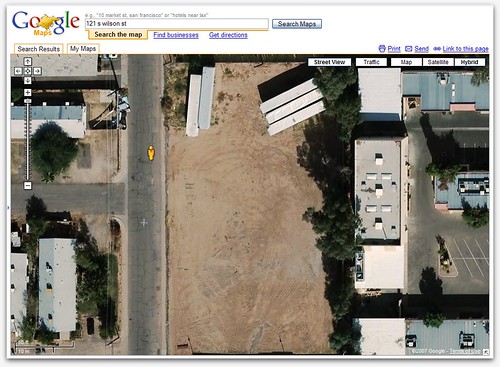
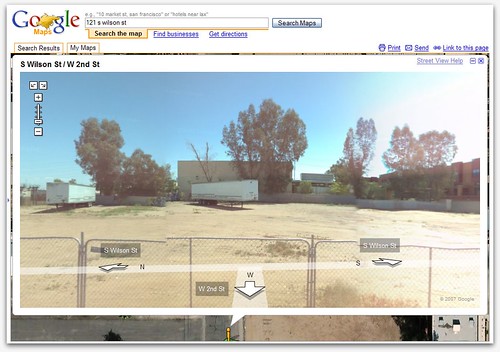
These are the low-level aerial view and the "Street View", from Google Maps, of the area around S. Wilson St. and W. 1st St., in Tempe, AZ. I lived here, in a rickety old house with holes in the floor, for a little over a year, in 1994 and 1995. Not only was there a swamp cooler instead of an air conditioner, there wasn't even a foundation; it stood on -- I kid you not -- a bunch of cinderblocks. How this is physically possible, I'm not really sure, but I am telling you what I saw. There was also a little stand of bamboo in the front that surrounded the stairs to the screened-in porch. Out back was a mesquite tree under which I put an ancient folding table, salvaged from someplace, and a chair found in the trash, and I used this as a writing spot almost every day for a year. Behind that was a seven-foot cinder-block wall, which hid the slow, slow freight trains from view. There was a little cat-door in the wall, consisting of a hole someone had sawed in the boards and a thick piece of transparent plastic nailed over it. Once when I locked myself out I actually managed to squeeze through this thing. I was thinner then. I occupied the house with a rather motley crew of college students, restaurant employees, and heroin addicts, plus a varying number of cats, several of whom died while I lived there. Periodically the landlords would come and flood the entire property with water from a garden hose in the vain hopes of creating a lawn, but the only result was that for the week that followed we would be plagued with mosquitos.
Anyhow, sort of in response to this post from Alan Levine, I idly surfed to Google Maps and had a look at the address from these two vantage points. It's unmistakable, as you surely can see for yourself: the house is gone. It's just dirt, with a couple of containers parked there. Who knows how old these photos are, but I'm guessing they're from this summer. Google Street View seems to get the expensive neighborhoods first, so maybe this area is up-and-coming. Probably a little Web research would tell me, but frankly I don't care. It reminds me of when, about a year and a half ago, my brother sent me this article, then already nine years old, about the closing of one of the shitty old biker bars I used to hang out in, a place called "Six East."
That's it. I felt sick suddenly in my gut seeing this. I don't know why. I didn't love the place. I didn't, and don't, love Arizona. I did a lot of things in that house I'm not particularly proud to remember. But it's weird turning on my computer and seeing that it's in the process of being swallowed up by condo properties, with expensive cars parked on the dirt lots instead of the ancient Subarus that seemed ubiquitous in the Phoenix suburbs in those days. It makes me me sad and angry at the same time, for no good reason. Well, good night, Arizona, and good night, everyone.
Tuesday, November 13, 2007
Google Maps as madeleine

Thursday, August 23, 2007
The semester begins tomorrow
This afternoon, I watched the minivans and SUVs pulling up to the college and disgorging their cargo of young college students-to-be, both eager and not-so-eager, along with the accoutrements, which in addition to the scores and scores of familiar milk-crates now include DVD players, window air conditioning units, and microwaves, all wrapped up in cardboard boxes and masses of packing tape. I watched this with the usual mixture of nervousness and excitement. The beginning of a new semester, for me, always means the chance to try again and maybe hit a little closer to the mark. I don't lose sleep the night before classes begin, not any more. But I still feel a little nervous every time I walk into a classroom, and the first day always seems like a momentous occasion; I tend to think, rightly or wrongly, that it will set the tone for the experiences of the next fifteen weeks. Not to mention that it'll affect my tenure bid, which is coming up, really, in just a matter of weeks now.

The first paradigm that shaped my pedagogy was the idea that the classroom should be an exciting place, never boring. And if boredom should prevail, then pedagogical strategies were needed that would intervene, alter, even disrupt the atmosphere. Neither Freire's work nor feminist pedagogy examined the notion of pleasure in the classroom. The idea that learning should be exciting, sometimes even "fun," was the subject of critical discussion by educators writing about pedagogical practices in grade schools, and sometimes even high schools. But there seemed to be no interest among either traditional or radical educators in discussing the role of excitement in higher education. Excitement in higher education was viewed as potentially disruptive of the atmosphere of seriousness assumed to be essential to the learning process. To enter classroom settings in colleges and universities with the will to share the desire to encourage excitement, was to transgress. Not only did it require movement beyond accepted boundaries, but excitement could not be generated without a full recognition of the fact that there could never be an absolute set agenda governing teaching practices.... But excitement about ideas was not sufficient to create an exciting learning process. As a classroom community, our capacity to generate excitement is deeply affected by our interest in one another, in hearing one another's voices, in recognizing one another's presence. Since the vast majority of students learn through conservative, traditional educational practice and concern themselves only with the presence of the professor, any radical pedagogy must insist that everyone's presence is acknowledged." (bell hooks, Teaching to Transgress: Education as the Practice of Freedom [NY: Routledge, 1994], pp. 7f.)I'm now reading bell hooks for the first time and finding her work really powerful. Here's something else from the book, something that hooks quotes:
Diversity that somehow constitutes itself as a harmonious ensemble of benign cultural spheres is a conservative and liberal model of multiculturalism that, in my mind, deserves to be jettisoned because, when we try to make culture and undisturbed space of harmony and agreement where social relations exist within cultural forms of uninterrupted accords we subscribe to a form of social amnesia in which we forget that all knowledge is forged in histories that are played out in the field of social antagonisms. (Qtd. in hooks, p. 31; from Peter McLaren, "Critical Multiculturalism and Democratic Schooling," International Journal of Educational Reform 1/4 [Oct. 1992]: 392-405).


Along with all this, I've also been gradually working on an essay on a peculiar course I taught a year ago. The course was pretty much conceived around the idea that my students and I would simply venture out into the wide world of religious otherness and try to make some sort of sense of what we saw together. In teaching it, I really walked away from any real claim to authority I might be able to make as a professor. I abdicated. I refused even to grade my students' work; I made them do it themselves. I think they may have thought I was crazy. Now, in thinking back on the events of that semester, I've figured one thing out. I'm not the greatest teacher. I readily admit that. In fact, I could go on for pages about my failings -- that's sort of a personality defect of mine. (In fact, I did go on for at least a paragraph in an earlier draft of this post, but I decided it didn't really add much to the point I was trying to sketch out.) In other words, there are things I can't do in the classroom -- things I simply can't succeed in teaching my students because of who I am and what my limitations are. But there are other limitations in place as well, limitations that have to do with our conceptualization of religion itself. I have gradually come to think that there's an aporetic element at work in the discipline of religious studies itself. Just look at the Euthyphro. There comes a point -- sometimes very early on in one's studies, sometimes after a lot of prolonged and intense digging -- when one throws up one's hands and says, "I am never going to be able to make sense of this." The trick is to recognize that moment and not to fight it, but also not to give up on the whole project when it comes. We need to teach, or perhaps better, to learn a kind of scholarly quietness in the face of the infinite, wild variety of human cultural practices. There are more things in heaven and earth, et cetera. The other problem, for someone like me anyhow, is that I can't use that as an excuse for my own limitations as a teacher. When my students walk for the first time into a Hindu ceremony, I want them to feel, briefly, the awkwardness and alienation that comes from seeing something that makes no sense. Of course, on the other hand, ideally, I also want them to walk in knowing as much as is practically possible about Hindu community, practice and thought. I don't know how to bring these things together effectively. What I don't want, and what I think is easy to let happen, is for students to have a bullet-pointed list of ideas and to translate what they see in that temple too rapidly into abstract, rationally-comprehensible ideas they've learned from a textbook or some reference source. That kind of thinking about religion lets us off the hook too easily. It makes it too tempting to avoid sitting with the raw, unnerving discomfort of sheer difference and outsiderness and unfamiliarity. Until you've really let that feeling sink in, I think -- and here I'm going to hazard one of those blanket statements that I usually try to stay away from, and which I'll no doubt come to regret -- I think you have no business believing you have answers to questions about other people's religious lives. In other words, if you haven't really felt in your gut the pathetic inadequacy of your own efforts to translate alien experience into familiar, comfortable conceptual categories, then you run the risk of falling into the old philosophia perennialis trap, describing all religious practice in the modern Western language of universalism, liberalism, rationalism and spirituality. If you have felt it, on the other hand, you're much less likely to succumb to the scholarly hubris of thinking that religion is basically a matter of beliefs and concepts. This aporia -- and again, I'm thinking of the Euthyphro -- is humbling and disorienting, but ultimately pregnant and salutary, I think.
I have to go to bed. So much for not losing sleep the night before classes start. But I had to get this off my chest. What ties it all together is the common thread of caring instead of knowing, and of grieving as a form of caring. We can't help seeking to understand, but in that search we have the potential to hurt ourselves and others, even as we bring some undoubted benefit into the world. I don't think that's just some kind of Faust-style romanticism. I think what hooks, Fink, Inchausti, and the various problems I ran up against in teaching that course all have in common is the idea that knowing -- at least, the kind that matters -- has to happen in a way that's embodied, social, and laced with emotion and danger.

I'm going to leave it there for now.
Saturday, August 11, 2007
My name is Bleetzork Ziddlebutt: conversations, the web, and teaching
Not long ago, I discovered Alan Levine's blog. Levine works in instructional technology, is connected with the New Media Consortium, and I believe he's the creator of -- or at least was somehow involved in the creation of -- the venerable and versatile Feed2JS service at Maricopa Community College. I'm not sure what got me curious about reading his blog -- maybe Bryan Alexander linked to it or something.
Anyhow. Brace yourself. This post is basically an extended, personal gripe about Web 2.0 and the social web. I have two complaints, and let me say right out that for the most part I have my tongue planted firmly in my cheek here, like the man says. However, I think this has some ramifications for the way technology is used in education, and I get to that at the very end of the post. Basically, I'm trying here to reflect a little bit on my own encounters with the technology of the social web (okay, "Web 2.0"), on the way it seems to have affected me, and what I think this might mean in the context of my own teaching praxis.
Okay. So, the first complaint. If Web 2.0 is all about this big social thing, it's, like, all one big conversation, then why doesn't anyone want to talk to me? I mean, I realize hardly ever say much of anything, but ... doesn't the magic of the web just automatically make conversations simply flower forth? Maybe not. Or maybe I'm just not that interesting! This point crystallized for me after I read Levine's post on "Facebook fatigue" and by extension social networking fatigue. In it, Levine complained that he was being overwhelmed by friend requests on Facebook, Twitter, and who knows where else. "No, Bleetzork Ziddlebutt," he wrote, "I do not want to be your friend." Well, ahem, Bleetzork Ziddlebutt -- that would be me, I guess. I was the source of one tiny piece of that deluge, having recently begun following Levine on Twitter and -- after posting a comment on one of his Flickr images -- added him as a Flickr contact. Well, to make a short story short, Levine didn't reciprocate. (He did, however, respond to my comment and then post a Twitter update with the link I tipped him off about, so I know he at least read what I'd said...) Now, I'm a big kid. Uh, my feelings aren't, like, hurt or anything. I swear. (Maybe just a little.) But hey, look, I'm a college professor. I'm a smart guy. I have a Ph.D. from Harvard. Why wouldn't people flock to be my friend, even if I never post a single interesting piece of content?
I then went on, similarly, to add a bunch of the other Web 2.0-in-the-classroom people as contacts in various web incarnations -- Barbara Ganley (Twitter and Flickr), Gardner Campbell (Twitter), and Jim Groom (Twitter), to name a couple. Groom, for reasons I cannot fathom, not only permitted me to follow his private Twitter updates but apparently is now following me as well, which, of course, greatly flatters my vanity, since Groom is something of a celebrity in this small field. The other two didn't respond -- not that I particularly expected them to, and, certainly, not that they were under any obligation to do so. (Bryan Alexander, on the other hand, who's a prince among men, has dealt with me several times in person, so he couldn't easily avoid friending me, like it or not.) In the meantime I continue to use Twitter, posting several updates a day (sometimes many more), usually extraordinarily inane. (In the most recent one, I bitched about having a stomachache and how Windows Movie Maker crashed.) I also continue to post photos to Flickr, though less in the last couple of weeks, and those are also very idiosyncratic: they're all either screenshots of stuff I think is interesting, photos of my kids, or peculiarly distorted cameraphone pictures of the area near where I live. I don't blog, not to speak of, basically because it's too damn much work, except for occasionally posting about my two lovely children, and even that's pretty much only for the benefit of the grandparents and other relatives.
Anyhow, what's struck me as I've observed this process is that most of the conversations on Twitter seem to be between people who know each other, or who are connected in one way or another, via real life already. This is pretty much true for me too. I've got fifty people following my updates on Twitter (the vast majority of whom are either robots or bulk-friend-adding types), but the only ones I regularly exchange substantive messages with are my brother, my next-door neighbor, two of my students (this one and this one, both of whom are smarter and harder-working than me), and, occasionally (she tends to ignore me most of the time) a rather breathtakingly brilliant poet, a former student of mine, who I turned on to Twitter some time back (at the time she thought it sounded ridiculous, I think, but now she's discovered some astonishingly creative ways to use it and has built up a significant fanbase; unlike almost all the other Twitter users I follow, her posts pretty much always have substance). For the record, there are thus far precisely two people on Twitter that I've actually exchanged messages with whom I've never met in meatspace.
I suspect that what's true of Twitter is also true, though maybe to a lesser extent, on most of the other "2.0"-style social Web environments -- blogs, Flickr, etc. Take Flickr. Some time back I added a woman who calls herself "~Kell~" (cute, huh) as a contact, I think because I saw her photos on another site I was using a lot at the time, Blipfoto (I've since abandoned Blipfoto out of a lack of time). Almost every day she posts attractive, cheery pictures of herself and her children, or occasionally something like a flower. (Recently -- I haven't been following too closely -- her grandmother got sick, so ~Kell~ posted some arty sepia-toned portraits of her, and even a hospital interior or two.) Every day her cheery photo posts get a dozen or so cheery replies, along the lines of, "You're great, Kell, love the pics!," or, on bad days, "Hang in there, Kell, we're rooting for you!" I'm not criticizing or being snarky here, I'm just pointing out that that's about as deep as it usually gets. My point is: much of the time, these aren't really "conversations" happening out there in cyberspace, they're more like nice people just touching base with each other. And indeed, that can be a very nice, civilized, friendly thing.
When I read the Twitter updates from Levine, Groom, Campbell, and Ganley, as well as a few others, I'm also struck by the same in-group quality. These are people who know each other, talking to one another as if they were at a private party. And why not? One of the things I find fascinating about Twitter is that when you post an update, it's like you're standing in a very large room full of all sorts of people, all talking about different things. Someone may hear you and answer you, and of course if your friends are there in the room, they're more likely to be listening. Potentially, someone who's not your friend might hear you, think what you're saying is interesting, and start listening along to your conversations. That's pretty much my situation -- I've been doing a lot of eavesdropping. It's interesting, but as I say, I'm struck by the semi-private, elliptical nature of many of the conversations. They're full of inside jokes and incomprehensible references (the "fake Reverend Jim"?).
So, why is this important? I guess it has to do with a growing sense on my part that this is really what the technology of the social web is for -- or, at least, that's what it does best: it supports and reinforces preexisting real-life relationships. And, more to the point for me, I wonder what this implies for those who are seeking to establish new, technologically-mediated forms of connectedness and community in an educational context. One of Alan Levine's longer recent posts was about the annual Faculty Academy at the University of Mary Washington in Virginia. I believe he wrote it as he was waiting for his plane out of town. In it, Levine said, basically, how wonderful the event was and how happy he was to have been there, and he gave a quick rundown of the participants and events. Many of the other participants responded in kind in the comments, thanking Levine for his post and for his contributions to the event. The whole thing seemed quite heartfelt and sincere. However, as an outsider reading the post and the comments, it was completely impossible to get any sense of what good the work of the Faculty Academy actually is. Teaching was mentioned, but only in very oblique, allusive ways, and there was never a mention of a specific course or an actual learning activity. The post was all about collaboration, innovation, team spirit, "new ways" of thinking, and the attraction of cool technology.
Now, I'm not trying to criticize Levine, or his work, by any means. It might sound as though I'm accusing him of superficiality, and I admit that that was probably my first reaction on reading the post. But it wasn't superficial. That wouldn't be a fair criticism. It was a blog entry, and I want to use it as an example of something I think is fairly common in this context. The post wasn't intended to be a meticulous critical evaluation, or even a thorough description, of Faculty Academy, and he was explicit about that. It was more in the vein of a personal journal entry. He was simply jotting down his highly enthusiastic reactions to the event while it was still fresh in his mind. But isn't that what blogging's mostly about? It's supposed to focus on informal, relaxed, off-the-cuff reactions to things. I guess it made me wonder what the real value of Web 2.0 technologies for education actually is. Levine is a great exemplar of the use of those technologies, but in his actual practice -- at least, inasmuch as it is exposed to the view of outsiders like myself -- the kind of critical reflectiveness that we want to model for our students doesn't really show up, the way it presumably would in an offline setting.
I don't mean to pick on him here. Indeed, I have more or less the same reaction to all the other people I've named, too. I'm excited by the educational possibilities of all this technology, and the "ethos" behind Web 2.0-style development is closely in accord with my ideas about what teaching ought to be: open, distributed, transparent, and social. I guess this post is mostly born out of my own disappointment at how things have gone so far. I've built blogs and wikis for my classes, but I don't really know how to use them. Students seem to think it's cool, too, but it's not clear precisely how anyone in my classes is benefiting from their use. In fact, they end up seeming more like a fun distraction. What is fundamentally clear to me, in particular, is that the seemingly transformative promise of Web technologies for teaching has not been borne out in practice, at least not in my practice, nor have I been able to see it clearly documented anywhere else. And God damn it, I really wanted it all to work. But so far, I don't see that it has. I see lots of potential, but not a lot of results, at least not yet, and not in a form I can recognize. Am I wrong about this? I hope so -- I really want to be corrected!
This post has meandered quite a ways from my initial half-serious complaining about how all the smart people on Twitter don't want to follow my updates. I do think there's a connection, though. The problem is that Web 2.0 technologies threaten to substitute a kind of superficial, marketplace-style sociability for real exchange. Actually, that's not true. The technology doesn't really have that much to do with it. Substantive, thoughtful exchange is always difficult. It's hard work. The web doesn't "threaten" that. What it does do, though, and I think this is the real problem, is this. It seems to promise to make those things easy, even though we know that's not the case. By holding out that silent promise, it threatens to make us forget how real human connections are forged --- over time and through lots of hard work -- and that they're usually a matter of embodiment as well. The "new" internet offers an endlessly fascinating world of connections and discoveries, but it's now easier than ever before to get lost ooh-ing and aah-ing at the shiny, fun toys and to think that they, themselves, are substitutes for the processes that they are actually intended to facilitate. I know that's happened to me, over and over again. I'd much rather fool with the design of a course website than actually think about what that website's supposed to do for the students. It's easier.
In fact, in a way, I'm probably doing that right now. I better go. Bye.


